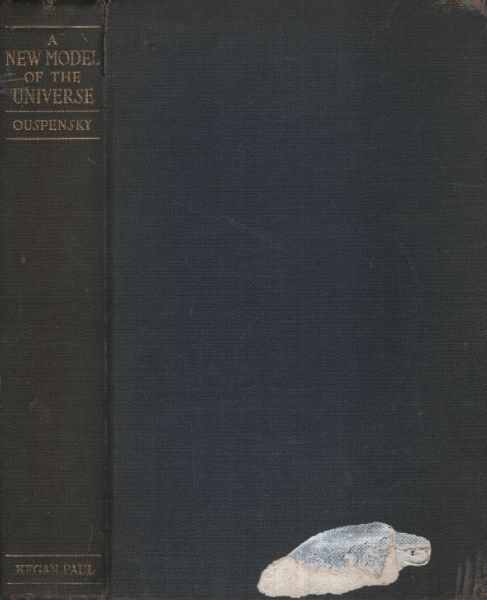
A New Model of the Universe. Principles of the Psychological Method In Its Application to Problems of Science, Religion, and Art
Alternative and self-help
088535
Kegan Paul, Trench, Trubner & Co.
London
1938
16×24,5
tvrdi
554
engleski
Price: 18,00 EUR
A groundbreaking philosophical and metaphysical work by the Russian philosopher and esotericist P. D. Ouspensky, first published in London in 1930. In this collection of essays, the author attempts to reconcile the ancient teachings of the East and the West with modern 20th-century science, especially the theory of relativity and quantum physics. The book serves as a profound examination of human consciousness, time, and the very structure of reality. Ouspensky analyzes space and time, arguing that time is actually the fourth dimension of space that our senses cannot fully perceive. The author elaborates on the idea that human lives repeat themselves in a closed time cycle, unless an individual reaches a higher level of consciousness in order to free themselves from this cycle. The book offers detailed analyses of Christian symbolism, tarot, and yoga, interpreting them as degenerate remnants of a former, much higher and purer knowledge. Through the study of dreams, hypnosis, and altered states of consciousness, the hidden potentials of the human psyche are explored. The work closes with an analysis of the role of sexual energy in the evolution of man towards the "superman", that is, towards higher stages of spiritual development. Although it contains early essays that Ouspensky began to develop in Russia around 1914, the book also reflects some of his later mature thinking after his encounter with the mystic G. I. Gurdjieff. His lectures based on these ideas attracted enormous interest from the intellectual elite of the 1920s and 1930s, including names such as Aldous Huxley and T. S. Eliot.


