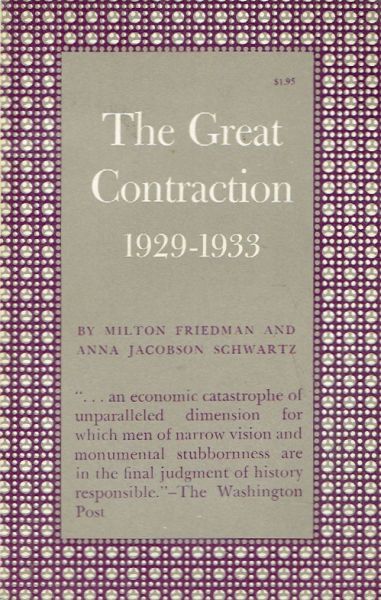
The Great Contraction 1929-1933
World in the 19th and 20th c.
086220
Princeton
1971
13×20
meki
150
engleski
Price: 18,00 EUR
This is a seminal work of economic history by Nobel Prize–winning economist Milton Friedman and his celebrated colleague Anna Jacobson Schwartz, ton Friedman and Anna Jacobson Schwartz, originally a chapter in their larger book, which argues that the severity of the Great Depression was primarily caused by the failure of the Federal Reserve to prevent a massive contraction of the money supply. Friedman and Schwartz argue that the Federal Reserve had the power and ability to stop the decline in the money supply and counter the banking panics but did not exercise its responsibility. Their analysis suggests that a different, more accommodative monetary policy could have made the Great Depression significantly milder. From August 1929 to March 1933, the stock of money in the U.S. fell by over a third. This unprecedented drop, far exceeding previous contractions, led to a sharp decline in prices, income, and employment. The authors highlight a series of major banking panics that led to widespread bank failures and massive withdrawals of currency from the banking system. They contend the Fed should have acted as a lender of last resort to support the banks and stem the panics. At the time of its 1963 publication, the prevailing Keynesian view held that monetary forces were passive during the Depression. Friedman and Schwartz's work offered a fundamental reinterpretation, emphasizing the profound importance of monetary policy in managing the economy and establishing the foundations of the monetarist school of thought. The work profoundly influenced the actions and policies of central banks worldwide. Former U.S. Federal Reserve Chairman Ben Bernanke acknowledged the importance of their work, stating in a 2002 speech that "You're right, we did it. We're very sorry. But thanks to you, we won't do it again" in reference to the Fed's failures during the Great Contraction. The book is celebrated for its marshaling of massive hi


