087657
London
1996
13,5×21,5
meki
318
engleski
Price: 15,00 EUR
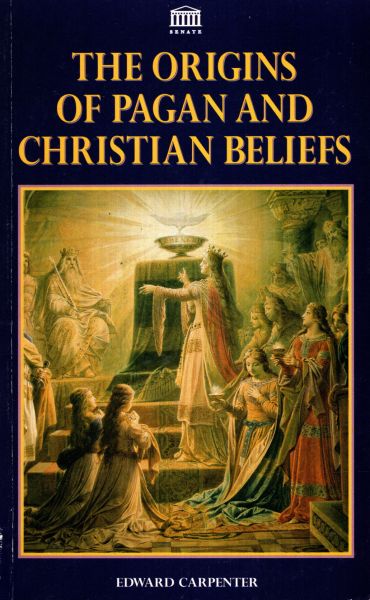
The Origins of Pagan and Christian Beliefs (originally published in 1920 as Pagan and Christian Creeds) is a seminal work by Edward Carpenter that explores the deep similarities and common roots of ancient pagan religions and Christianity. In the book, Carpenter uses the comparative method to argue that Christian dogmas and rituals are not a unique revelation, but rather an evolutionary continuation of older traditions. The author draws parallels between pagan "savior gods" and Jesus Christ, as well as between pagan mother goddesses and the Virgin Mary. The book explains how the Christian Eucharist (communion) has its roots in the totemic sacraments of ancient cults in which believers ate the body of a god in order to receive his power. Carpenter emphasizes the influence of solar and lunar myths on Christian holidays. For example, he associates the birth of Jesus on December 25 with the winter solstice, when the Sun is "reborn". The work offers a three-stage theory of the evolution of religion: 1. Physiological cults: Focused on fertility and nature. 2. Magic cults: The development of fear of ghosts and the need for redemption. 3. Spiritual self-awareness: The striving for universal unity, which Carpenter believes is best expressed in the teachings of the Upanishads (to which he devotes a special appendix in the book). Edward Carpenter (1844–1929) was an English socialist philosopher, poet, and early gay rights activist. His work often combines mysticism with social reform, promoting the idea that civilization is a "disease" from which humanity must heal itself by returning to nature and developing inwardly.


