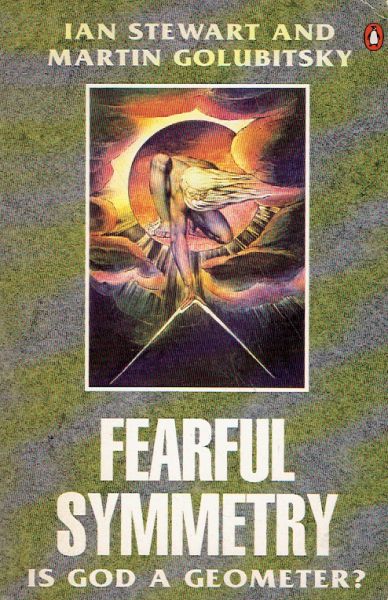
Fearful Symmetry. Is God a Geometer?
Matematika, statistika i informatika
087360
London etc.
1993
12,5×19,5
meki
287
engleski
Cijena: 10,00 EUR
"Fearful Symmetry: Is God a Geometer?" (1992) is a popular science book by mathematicians Ian Stewart and Martin Golubitsky that explores how symmetry and symmetry-breaking govern the patterns of the natural world. The book argues that while the laws of nature often possess deep, perfect symmetries, the complexity and variety we see around us—from tiger stripes to the movement of animals—actually arise when those symmetries are "broken". The authors address a fundamental paradox: why do symmetrical causes often lead to asymmetrical effects? Using more than 120 illustrations, the book demonstrates how symmetry principles explain diverse phenomena, including: Biological Forms: The gaits of animals (trotting vs. galloping), the structure of viruses, and the markings on a leopard's skin. Physical Systems: The formation of snow crystals, the buckling of beams, and the behavior of subatomic particles. Cosmology: The overall structure of the universe and how gravitational forces clump galaxies together. Group Theory as Language: While largely avoiding complex formulas, the book uses group theory as the mathematical framework to describe how things look when rotated or reflected. Philosophical Inquiry: The title's question, "Is God a Geometer?", references the ancient idea that a divine mind designed the universe using geometry, though the authors focus on mathematical laws as the underlying "geometer".


