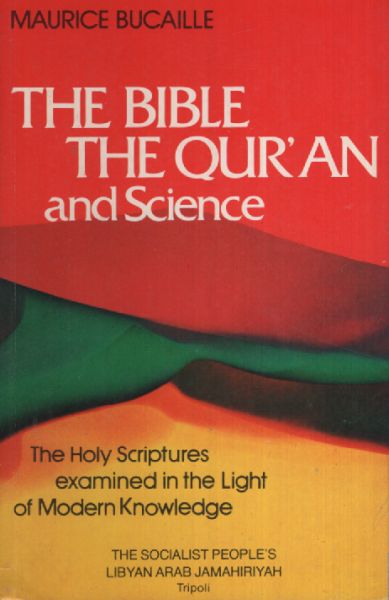
The Bible, the Qur'an and Science. The Holy Scriptures Examined in the Light of Modern Knowledge
Religija - knjige
088460
The Socialist People's Libyan Arab Jamahiriyah
Tripoli
12×18,5
meki
254
engleski
Cijena: 15,00 EUR
It is a well-known work published in 1976 by the French physician Dr. Maurice Bucaille. The book explores the sacred texts of monotheistic religions and analyzes them through the prism of modern scientific knowledge. This work has gained great popularity in the Islamic world because it advocates the thesis that the Qur'an does not contain scientific errors. Bucaille claims that the Qur'an contains descriptions of natural phenomena that are in perfect agreement with modern science. He mentions topics such as the creation of the universe, astronomy, embryology, and the development of the fetus in the womb. The author concludes that these texts could not have been created in the 7th century without divine revelation. Unlike the Qur'an, the author believes that the Old and New Testaments contain parts that do not match proven scientific facts. He attributes this to human errors, copying, and later changes to the texts throughout history. Despite the differences, the book emphasizes the continuity of revelation from the same God. The author calls for spiritual unification and better dialogue between Jews, Christians, and Muslims. Maurice Bucaille was a respected French surgeon and gastroenterologist. During his career, he was also the personal physician of King Faisal of Saudi Arabia. In order to be able to study the sacred texts in detail in the original language, he learned Arabic in his later years. His approach to the analysis of religion gave rise to an entire school of thought in apologetics, often called "Bukhariism." Although the book was praised by many believers, it was often criticized in academic and strictly scientific circles for its selective interpretation of words and its overly liberal interpretation of scientific terms in ancient texts.


