086917
London etc.
1992
12,5×19,5
meki
173
engleski
Cijena: 10,00 EUR
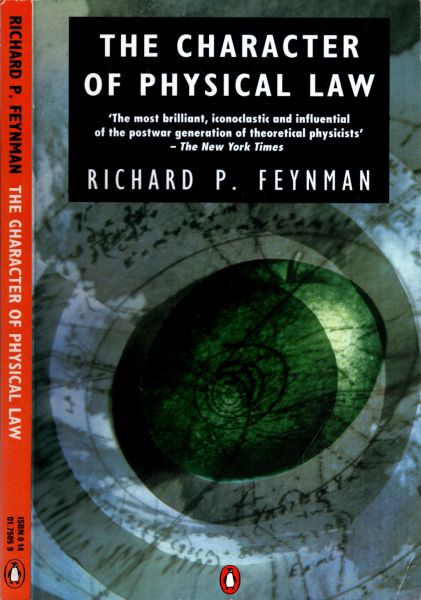
The Character of Physical Law is a celebrated book by Nobel Prize-winning physicist Richard Feynman, based on a series of seven lectures he delivered at Cornell University in 1964. The work is famous for its accessible, witty, and enthusiastic approach to complex scientific concepts, using everyday illustrations to explain the "character"—the common features and styles—of the laws that govern nature. The book is structured around seven key topics that define the nature of physical laws: The Law of Gravitation: Feynman uses gravity as his primary example of a physical law, explaining how a single elegant mathematical principle can describe everything from falling apples to the orbits of distant planets. The Relation of Mathematics and Physics: He argues that mathematics is not just a tool but the essential language of nature; without it, one cannot fully grasp the deep logic and beauty of physical laws. The Great Conservation Principles: This lecture covers fundamental rules that never change, such as the conservation of energy, momentum, and charge, which act as the constraints within which nature operates. Symmetry in Physical Law: Feynman explores how nature remains unchanged under certain transformations (like reflection or rotation) and where these symmetries sometimes break. The Distinction of Past and Future: He addresses the "arrow of time" and entropy, explaining why certain processes (like a glass breaking) happen in one direction even if the fundamental laws of motion are reversible. Probability and Uncertainty: He introduces the quantum mechanical view of nature, explaining that at the smallest scales, we can only predict probabilities rather than exact outcomes. Seeking New Laws: In the final lecture, Feynman describes the creative process of scientific discovery—which he famously summarized as: "First we guess it. Then we compute the consequences... if it disagrees with experiment, it is wrong".


