The Culture of Power in Serbia. Nationalism and the Destruction of Alternatives
Srbija i Srbi - knjige
085784
The Pennsylvania State University Press
University Park, Pennsylvania
1999
15×22,5
meki
230
engleski
Cijena: 30,00 EUR
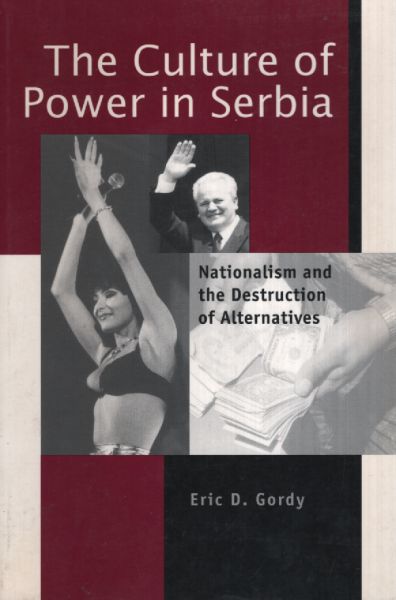
In his 1999 book, sociologist Eric D. Gordy examines how Slobodan Milošević’s regime maintained authority despite economic collapse, military defeat, and international isolation. Gordy argues that the regime stayed in power not necessarily through broad popularity, but by systematically destroying alternatives in everyday life. By closing off alternative voices in politics, media, and culture, the regime left citizens with no viable options but to remain passive or compliant. The book identifies four specific areas where the regime eliminated alternatives to its rule: ,manipulating the political landscape to ensure no organized opposition could effectively challenge the Socialist Party of Serbia (SPS), controlling information flow to isolate citizens from reality and neutralize dissenting views, co-opting cultural expressions, particularly through the promotion of "turbo-folk"—a genre associated with the regime's nationalist ideology—while suppressing alternative rock and independent music scenes and exploiting hyperinflation and economic hardship to keep the population focused on survival, thereby draining the energy required for political resistance. Gordy concludes that while the regime successfully demoralized the public, its control was never absolute. He noted that the failure to fully co-opt popular music and the partial success of independent media suggested the regime's strategy had a limited future, a prediction validated by the 2000 revolution.


