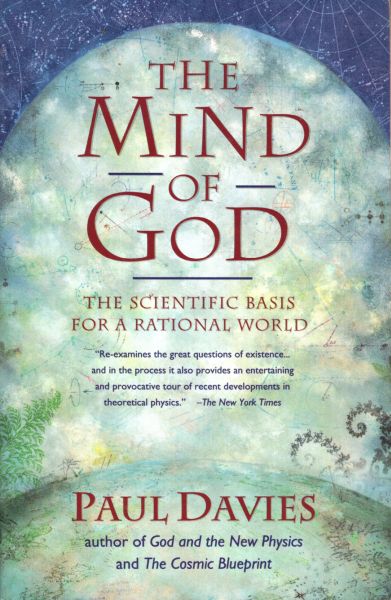
The Mind of God. The Scientific Basis for a Rational World
Fizika, kemija i astronomija
087287
New York
1993
14×21,5
meki
254
engleski
Cijena: 12,00 EUR
This is a non-fiction book by theoretical physicist Paul Davies that explores whether modern science can provide an ultimate explanation for the existence and rationality of the universe. The book bridges the gap between science and metaphysics, examining several key concepts: The Rationality of Nature: Davies argues that the universe is governed by precise mathematical laws that are discoverable by human reason. He views this "cosmic code" as a profound mystery—why should abstract human mathematics describe the physical world so perfectly? The Origin of the Universe: He examines theories like the Big Bang and quantum creation, questioning whether the universe could have "created itself" from nothing through quantum fluctuations. Fine-Tuning: Davies discusses the Anthropic Principle, noting that physical constants (like the strength of gravity) seem precisely balanced to allow for the emergence of life. Consciousness and Purpose: He rejects the idea that human existence is a random accident. His famous conclusion is that we are "truly meant to be here," as conscious beings allow the universe to generate self-awareness. Limits of Reason: Invoking Gödel’s Incompleteness Theorem, Davies suggests that science and logic may never provide a complete "Theory of Everything" because any logical system has limits that require something outside itself for a full explanation. Davies does not advocate for a traditional, personal religious deity. Instead, he uses "the Mind of God" as a metaphor—borrowed from Stephen Hawking—to represent the underlying rational order and mathematical elegance of the cosmos. He suggests that through scientific inquiry, we are essentially "glimpsing" this deeper level of reality. The book is lauded for making complex physics accessible and for its stimulating interdisciplinary approach. Davies was awarded the Templeton Prize in 1995 partly for the work explored in this book.


