084572
New York
1970
16×24
tvrdi
496
engleski
Cijena: 13,50 EUR
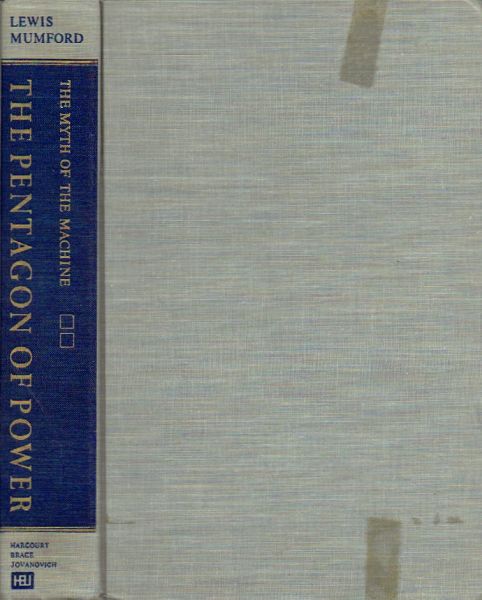
The Myth of the Machine is a two-volume book by Lewis Mumford that takes an in-depth look at the forces that have shaped modern technology since prehistoric times. The first volume, Technics and Human Development, was published in 1967, followed by the second volume, The Pentagon of Power, in 1970. Mumford shows the parallel developments between human tools and social organization mainly through language and rituals. It is considered a synthesis of many theories Mumford developed throughout his prolific writing career. The "Pentagon of Power" refers to five aspects of what Mumford calls "the new power complex" of military and industry in industrialized nation-states: Politics, Power (in the sense of physical energy), Productivity, Profit and Publicity. The "pentagon" was also clearly selected to be in reference to the Pentagon, regarding which Mumford commented: "The concrete form of the Pentagon in Washington serves even better than its Soviet counterpart, the Kremlin, as a symbol of totalitarian absolutism: all the more because this particular megastructure combines a pathetically outmoded Renascence plan with the current wasteful and inefficient facilities for monotransportation by car." Mumford found an important aspect of the Pentagon, as a physical structure symbolizing the object of his critique, the way that it functions as an enclosed "citadel" in which the U.S. military's elite make decisions, cut off from the world in which they act. Although much of the volume explores the negative influence of centralised power and exploitative behaviour on the human condition, it finishes on a positive and optimistic note in the closing chapters.


