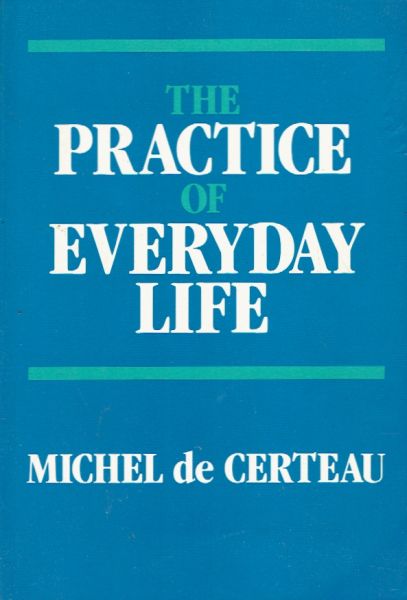
086748
University of California Press
Berkeley - Los Angeles - London
1988
15×22,5
meki
229
engleski
Cijena: 7,50 EUR
Michel de Certeau’s The Practice of Everyday Life (1984) argues that consumers are not passive, but active "users" who employ "tactics" to subvert dominant "strategies" of institutions and power. It highlights how ordinary people repurpose, resist, and creatively navigate social, cultural, and urban landscapes. Strategies are the methods used by established institutions (businesses, government) to create a sense of place and control. Tactics are the, often fleeting, actions taken by individuals to manipulate these spaces for their own purposes. De Certeau reframes "consumers" as "users" who creatively adapt products and spaces to their own interests, a form of "hidden production". He explores how walking in a city, for example, is a tactic that ignores the pre-planned, "panoptic" design of urban planners, effectively turning a "place" (a fixed, ordered layout) into a "space" (a lived, experienced, and constantly changing environment). The book focuses on mundane, everyday activities such as cooking, reading, and walking as forms of resistance against the dominant order. The work draws on a wide range of fields, including sociology, anthropology, and psychology, to understand how individuals reclaim their own autonomy within a culture of consumption. Translated by Steven Rendall.


